
 Add us as a preferred source on Google
 In today’s world, mobile apps have taken over the daily lives of all people. Thanks to the accessibility of mobile applications, people can no longer overlook a service or product. Milk delivery services are expanding due to the increasing need for high-quality, fresh dairy products delivered directly to customers’ doorsteps. Amid busy lives and evolving customer preferences, developing a milk delivery app offers an ideal and efficient solution.
Through these milk delivery apps, it is no longer necessary to go to the dairy store and purchase products daily. Simply sign up on the app, select the quantity of milk or other products you would like to purchase, choose the location, and have the milk delivered whenever and wherever you’d like. Isn’t it amazing?
Delivery apps for online milk provide businesses with an economical way to run the delivery process and connect with more people while also offering customers the ability to receive fresh dairy and milk products right at their doors. They allow farmers and dairy businesses to supply clients with fresh, doorstep-delivered milk and dairy products via a single platform.
Dairy products are accessible to us, yet there aren’t enough dedicated milk delivery apps. This presents a fantastic chance for businesses that wish to enter a profitable and promising market.
In this blog, we will discuss the development of a milk delivery app, covering its features, steps, and much more.
What Is A Milk Delivery Mobile App?
Like every other mobile app, the milk supply app facilitates the ordering and delivery of milk to consumers. They can easily order milk or milk products from milk delivery apps. These apps bring convenience to consumers and open revenue opportunities for local milk sellers.
Milk delivery is a low-investment business, and entrepreneurs saw the situation as an opportunity and invested in milk delivery app development. It is beneficial for both consumers and dairy companies in several ways.
Consumers can easily download an app for milk delivery and get it delivered to their doorstep without the need to go to the stores. These apps are flexible, allowing consumers to choose delivery time and payment mode accordingly.
Milk delivery app development is also beneficial for dairy companies as it brings them ease of convenience. They can easily manage their order tracks and handle payments on a single platform.
With these benefits being said, let’s discuss how the milk delivery app works.
How Does A Milk Delivery App Work?
A milk delivery app works similarly to other on-demand delivery apps. It has a simple and user-friendly interface that makes ordering quick and easy. Customers can manage everything from browsing to making payments using their mobile phones. Additionally, customers can select their preferred quantity and product, and schedule milk delivery at their convenience
Here Is How It Works For Customers
Simple Signup Process
First, download the milk delivery app, then you can easily sign up with your Gmail ID or Google account. The advantage of signing up for a Gmail account is that customers do not need to remember their login credentials every time they sign in.
Adding a product to your cart
Customers can select their required product and its quantity. For example, they can choose the type of milk they want, such as fat-free or lactose-free. Customers are also free to choose the quality, like one or two liters of milk, before adding it to the cart.
Select delivery options
Customers can place a one-time order or subscribe for regular milk delivery, according to their requirements. They also have options to choose from, like same-day, custom-day, or alternative-day delivery.
Payment process
On these milk delivery apps, users can easily make payments through secure payment gateways. Customers can make payments through online or offline modes. These online payment options are completely safe and secure.
Order confirmation
Customers receive a confirmation email or app notification after completing the payment process. It includes information such as the quality of milk, the total bill, and the estimated delivery time.
How it Works for Milk Vendors
Milk vendors play an important role in the seamless milk delivery process. With the help of app development services, businesses can ensure that suppliers and vendors can manage orders, product stock, and delivery.
Processing an Order
Once the customers have confirmed the order, the app confirms it by verifying the payment process and notifying the milk vendors. It assists the suppliers in preparing orders and delivering milk on time.
Checking product availability
Milk delivery apps track what is in stock and update what is available. It also checks how much stock will be required for the day based on previous orders. It also helps suppliers and milk vendors to have enough quantity of milk to manage a continuous supply.
Optimization of delivery routes
The app incorporates intelligent ways of determining the most efficient routes for delivery depending on traffic, distance, and delivery time. It assists vendors in saving time and fuel and delivering goods promptly.
Assigning Orders to Delivery Person
Once the order is ready for packing, the app sends a notification to the nearest delivery person. It helps with the timely delivery of the order and reaching customers as soon as possible.
Delivering to the Customer
The delivery person follows the route shown in the app and delivers the milk to the customer’s doorstep. The app can also provide customers with live delivery status updates.
How It Works For Delivery Drivers
Delivery Updates
After an order is placed by customers, the delivery person receives updates. It helps them to plan delivery routes and manage delivery schedules without any delay.
Pickup from Vendor Location
Delivery drivers go to the vendor’s location and collect the order. Milk delivery apps categorize all the nearby delivery locations together to help drivers. It helps drivers to save time and deliver orders on time.
Proof of Delivery
The delivery person can take the customer’s digital signature and a photo to update the app after the delivery is successful. It ensures that each delivery is verified and reaches its customers.
Collecting Cash Payments
Many customers choose cash-on-delivery options; drivers have to collect the amount and update it on the app. App system automatically updates the admin panel and sends OTP to the customers for the payment confirmation.
Updating Delivery Status
Delivery persons can update the status of the order on the app, such as canceled, delivered, re-attempted, or delayed. This puts the customers and vendors in one loop and helps in clear communication.
Why Invest in Milk Delivery App Development?
Have you heard that milk delivery has been growing, and it’s predicted to increase even more? Here are some fascinating statistics about the market for online milk delivery:
- The global dairy food industry is forecast to grow at a 6.40% CAGR during the forecast period and reach $1,374.37 billion by the year 2030.
- It is estimated that the dairy products marketplace will reach maturity at a rate of 5.2% from 2019 and grow to $645.8 billion by 2025.
- Within the milk market, the number of milk users is expected to reach 251.1 million by 2029.
- The total revenue from the dairy market is valued at $71.38 billion in 2024. It is predicted to increase each year by 6.77%.
Europe is said to be the largest producer of dairy, accounting for 36% of the dairy market value worldwide. So, there is plenty of room for growth.
- The global dairy food industry is expected to reach USD 1,374.37 billion by 2030. India is said to be the second-largest producer of milk after the European Union.
These data show that there is less competition in the online milk delivery market, and there is a good probability of getting a good market share in no time.
Moreover, with mobile apps, you can reach a broader audience, creating a sense of brand awareness and loyalty among the customers. To take your milk business online, partner with us and enter the digital market.
Types Of Milk Delivery Apps
If you are a milk producer and sell various dairy products, then, in addition to a milk delivery mobile app, there are a few more types that you can develop. Check them out down below.
Subscription-Based Dairy Delivery Apps
These applications allow customers to schedule regular deliveries of milk and various dairy products. Users can customize their orders’ desired frequency and amount, customizing them as needed. The app automatically bills the customer’s payment method and updates the delivery schedule accordingly.
On-demand Milk Delivery Apps
These apps cater to customers requiring immediate milk and dairy product delivery. Users can browse the available items, select, and place orders within the app. Delivery drivers then collect and deliver the orders to customers’ doorsteps within a specified timeframe.
Farm-to-Door Milk Delivery Apps
With these applications, customers have the opportunity to receive fresh milk and dairy products directly from local farms. The app allows users to browse through the offerings, place orders, and track their deliveries. By eliminating intermediaries, these apps reduce costs and ensure that customers receive the freshest products possible.
Hyperlocal Milk Delivery App
Such apps aim at the users of a specific geographic location. It lets users directly connect with local dairy product distributors who deliver fresh dairy products, like milk, to their doorsteps. Today, people are becoming more conscious about what they consume. The Hyperlocal milk delivery app lets users connect directly with the vendor without any intermediary.
All-in-One App
You can build a super app for your milk delivery business where you can embed the facility of every type of app you can develop (above-mentioned). You can include subscription, hyperlocal, and farm-to-door facilities under one umbrella. Leveraging this, users can subscribe to the milk delivery app, connect directly with local dairy farmers, or choose 10-minute delivery directly to the home.
Benefits Of Creating A Milk Delivery App
Building a mobile app for milk delivery offers convenience to users, making it a valuable tool for modern consumers. Beyond this, there are several other benefits of developing a milk delivery app. Take a look.
Data Collection
AI-powered milk delivery app development will ease data accumulation relevant to customer preferences, behavior, and purchase history. A business owner can analyze the data and customer experiences, increasing customer loyalty and satisfaction.
Inventory Management
The predictive analysis of customer data can surface the upcoming demands for milk and milk products. Acknowledging this as an opportunity, you can efficiently manage inventory, making milk available to meet customer demands.
Increased Order Value
The order value that an on-demand milk delivery app can drive, traditional businesses have some limitations. For example, a milk vendor can only deliver milk and its products to its accessible areas. However, the mobile app will increase order value by covering a broader customer base.
Payment Management
Gone are the days when milkman needed to handle their invoices manually. Now, all the data is stored on the platform, which can be accessed anytime and anywhere. Additionally, the payment gateway integration in your milk delivery app will help you manage your payments seamlessly.
Discounts and Deals
Discounts and deals are the best way to increase your customer base and create brand loyalty. Via your app, you can offer various discounts and deals to your customers to increase sales and boost their long-term engagement with your app.
User Management
Integrating your milk delivery app with a CRM lets you easily manage your milk business’s overall operations. Also, you can offer better customer support and resolve their issues quickly. This results in improved customer experience and increased engagement.
What Are The Attributes Of A Successful Milk Delivery Business?
Here are some essential attributes that must be present in your milk delivery app to ensure a feature-rich, fully functional deliverable.
Assured Delivery Early Morning Every Day
Milk and milk-based products are necessities in every household to kick-start the day. A good milk delivery app should offer free delivery of all the items before 7 am every morning. Timely delivery will not only enhance user trust but also increase their engagement.
No Minimum Order
This is another vital attribute that persuades more and more customers to buy from you. Eliminating minimum order requirements caters to a wider range of customer needs. They can purchase only what they require.
Order Late, Get It by Early Morning
A large segment of milk app delivery customers is working individuals who struggle with long office hours each day. For the convenience of such people, your app must allow users to add anything they want to the basket anytime till midnight and receive fresh products at their doorstep the next morning.
A Hassle-Free Refund Policy
A simple refund policy helps to build customer trust in the app. They are much more likely to order from your app if they know they can return it easily. Only in such cases when the product quality is not up to the mark, or the wrong product is received.
Discounts on Everyday Items
Attractive deals and daily discounts encourage more sales and keep the users engaged. You can offer regular promotions on essential items and create an urgency that motivates customers to make purchases more frequently. This strategy helps boost sales and enhance customer retention.
A Range of Branded Products
For aggregator apps, it is a great idea to sell a wide assortment of branded products to draw more customers. You can feature some well-known brands and instill a sense of trust and quality in your offerings, making users more likely to choose your app over competitors.
Quick and Easy Payment Modes
Payment checkouts, OTPs, and CVVs at every transaction are a big turn-off for users, especially those who like to order daily. A successful milk delivery app comes with a simple top-up wallet that enables customers to continue shopping without any hassles of entering CVV or waiting for OTP every time they purchase something.

General Features To Consider When Building A Milk Delivery Mobile App
The end user of a milk delivery app can be the admin or mobile app owner, milk delivery agent, or user/consumer. For each user, you need to include specific features and functionalities.
For User Panel

| Registration and Log-in | Users register on the milk delivery app and log in to the app. |
| Profile | This feature lets users add and edit their details, such as name and address. |
| Search and Filters | Allow users to search for the products they want, applying filtering options like quantity, flavor, type, etc. |
| Order Tracking | Users can use this feature to track their orders and know the status and expected delivery timing. |
| Order for Friends and Family | This feature allows users to place orders and pay online for their friends and family using their accounts. |
| Secure Online Payment | The app owners can offer users secure in-app online transactions by integrating a payment gateway. |
| Order History | By viewing past purchases, users can reorder the same item just by clicking the “reorder” button. |
| Notifications and Alerts | Users are notified about their orders and other details through instant notifications and alerts. |
| Subscription Management | The milk delivery app users can subscribe to daily, weekly, or monthly deliveries, set their preferences, and customize their delivery schedules. |
| Promotions and coupons | Integrating promotional offers and coupons encourages user engagement and repeat purchases. Make sure users can easily apply these discounts during checkout. |
For the Delivery Agent Panel
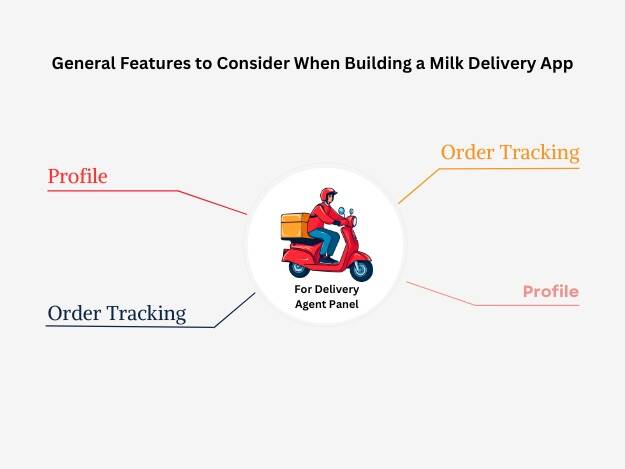
| Notification & Alerts | The driver agent gets notified of the order placed with relevant details, like pickup and drop-off location, scheduled time, and more. |
| Navigation and In-App Map | The in-app map integration eases drivers with route optimization, high-traffic alerts, and directions to the delivery locations. |
| Delivery Status Confirmation | This feature lets the drivers update the delivery status, whether it was successfully delivered or missed. |
| Orders Planning | This app feature will ease the order planning for drivers by arranging them according to varied factors, like delivery location, type, etc. |
For Admin Panel
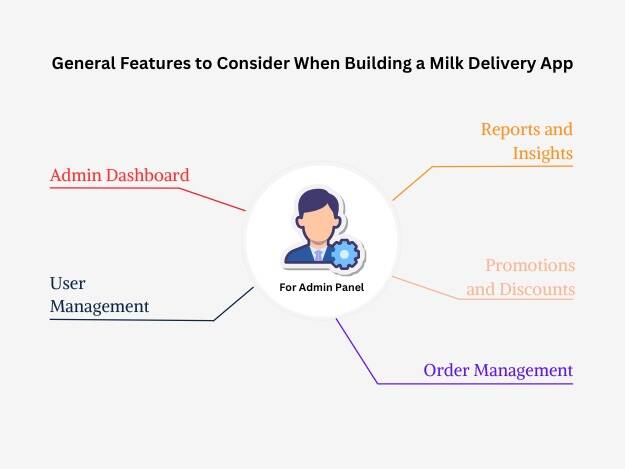
| Admin Dashboard | The app owners can use the dashboard to manage their business, orders, sales, key metrics, and more. |
| User Management | The admin can use this feature to manage their inventory, keep track of stock levels, enable out-of-stock alerts, and avoid running out of stock situations. |
| Reports and Insights | To create detailed reports and insights, the admin can analyze accumulated customer data and provide an improved online shopping experience. |
| Promotions and Discounts | The app owners can create and manage discounts, deals, campaigns, and loyalty programs. |
| Order Management | On the arrival of orders, the drivers can use this feature to manage every order and make it ready, holding the specific customer’s details. |
For Milk Service Provider Panel
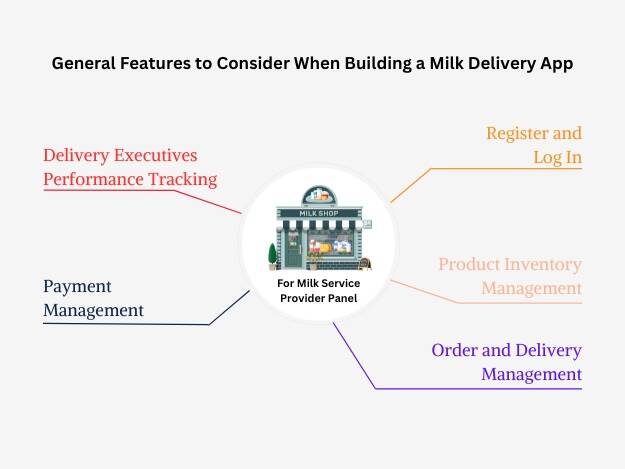
| Register and Log In | The milk providers will use this feature to register and log in to their app account. |
| Product Inventory Management | In this, the provider can list the products they want to send with their details, like size, price, type, and more. |
| Order and Delivery Management | The milk service providers can manage orders and product delivery based on the demands and orders placed. |
| Payment Management | This feature eases the order payment management for milk providers. |
| Delivery Executives’ Performance Tracking | The milk provider can track the performance of the delivery executive to improve productivity. |
Note: If you want to make an aggregator app allowing different milk providers to sell farm-fresh products through a single app, you need to add one more panel, the milk service provider panel, along with the others, with the features below.
Advanced Features And Functionality In A Milk Delivery App
Your milk delivery app should be easy to navigate, and this is only possible when you integrate some essential advanced features and functionality. That not only enhances user experience but also provides value at the same time. So, before creating a milk delivery app, explore them below.
Bulk Ordering
While other milk delivery apps don’t allow ordering more than 1 or 2 quantities of any specific product, you can change this trend and append a bulk ordering feature to your app. This way, when you meet the common needs of your customers, more users will turn to your mobile app.
App Wallet
Integrating the app wallet in your milk delivery mobile app can ease users in online payment and pre-authorized payment management, like subscriptions. Besides, the wallet can provide a top-up facility when it is insufficient.
AI-powered Analysis
Making your app AI-powered will help you with your customer data analysis, their preferences, behavior, and purchase history. Using this, you can recommend products and enhance their customer experience.
PIP Mode
This is a great feature for all micro-delivery service apps. When the customer’s order is out for delivery, a floating window appears on the screen within the mobile app that enables them to check the location of their order.
Schedule Delivery
You can make your milk delivery app even more useful to users by allowing them to schedule their delivery at their preferred time, at their convenience. This feature will help work professionals who spend less time at home.
Multi-lingual Support
With the multilingual support feature, you can make your app accessible to a broader audience, accommodating users from diverse linguistic backgrounds. Moreover, the app’s availability in different languages will give you a competitive advantage in local markets.
PIM Integration
Integrating the Product Information Management (PIM) module within the app helps store all the product details and information in one place, facilitating effective decision-making. This centralized system ensures that all product data, including descriptions, images, pricing, and inventory levels, is regularly updated.
Some Future Trends For Milk Delivery Apps
If you want to thrive among the best milk delivery mobile apps, you need to make your app ready for the future. For this, you must adhere to the latest trends and technologies to meet the changing demands of the consumers in the dairy market.
Here are some trends that milk supply businesses can consider to catch up with changing demands.
Integration of Blockchain for Transparency
Implementing blockchain technology into your dairy product delivery apps can enhance transparency in sourcing and production processes. Customers will have access to verified information about the origin of their milk and dairy products, fostering trust and accountability.
IoT-Enabled Freshness Monitoring
Today, some of the best apps for milk delivery are monitoring the freshness of products by utilizing IoT. Sensors can track temperature and storage conditions. This ensures that customers receive only fresh dairy items.
Order Tracking with GPS
Order tracking with GPS allows users to monitor their deliveries. The Super Dairy app has GPS tracking features that simplify item tracking. With this feature, customer trust is enhanced, and customers get updates on the status of their orders.
Sustainability-Focused Partnerships
Future milk delivery software will likely prioritize partnerships with eco-friendly farms and suppliers. If you want your app to be the best milk delivery app in the future, start promoting sustainable practices and offering organic options.
Automated Delivery via Drones or Robots
The integration of automated delivery systems, including drones and robots, is going to revolutionize the dairy products delivery app landscape. This innovation can significantly reduce delivery times and operational costs while enhancing efficiency.
Monetization Opportunities Offered By The Milk Delivery Apps
While making your milk delivery app, you need to think about how you can generate revenue from it. For that, you need to opt for varied strategies. Here, we have showcased a few:
Featured Listing
In this, the app owners can offer top spots on their app’s home page to a few milk retailers in exchange for a fixed amount of money. A lot of retailers opt for this because the companies that appear at the top receive maximum visibility and sales.
Sales Advertising
This is a useful monetization technique that enables app owners to earn money by showing advertisements for other products or services on their app. It is a common model used by most app owners. In return for displaying the ads on your app, you can charge a specific amount of money from the advertising businesses.
Subscription Model
You can provide subscription plans to your app users where they can subscribe to premium milk delivery services. This monetization method will increase customer loyalty and be a constant revenue source.
Commission-Based Model
In this monetization model, you can let other local dairy farms or milk producers list on your app and connect with customers. In exchange for this service, you can charge an amount as a commission. Among the other models, this is usually chosen by businesses.
How To Develop A Milk Delivery App?
After knowing the chief aspects to include while you build a mobile app for a milk delivery business, let’s go through the development steps.
In-Depth Market Research
Before starting something new, you need to know it from every possible angle. Start with deep market research, the existing competitors, the expected growth, and more key metrics. This will help you understand what will work for you in the long run.
Features and Functionalities Selection
Next, list out the features and functionalities that you want to include in your milk delivery app and that can make your venture stand out uniquely. Ensure that you opt for the ones that may grab your users’ attention and appear useful.
Choose the Right Tech Stack
Aim to include popular technologies and tools while you develop milk delivery apps and provide them with value. This is a tech move and will need technical advice. For that, you can hire a milk delivery app development company and get expert guidance.
Focus on Engaging App Design
Your app’s design can be a major factor in improving your profit. Try making it engaging, easily navigable, and user-friendly. Also, make the order process short and shouldn’t take long to be placed, as users may find it hectic and will leave.
Start App Development
Now that you have everything at your reach, the features, functionalities, design attributes, and tech stack, it’s time to kickstart app development.
App Testing
After the app development, the QA engineers will test your app, locate the issues and bugs, and resolve them, ensuring seamless working.
App Launch
Now, your app is set to be used by end users. The app developers will deploy your app on the respective app store, and it will be available for download.
Ongoing Support and Maintenance
Building an app doesn’t end the app development process; constant support is essential for seamless app performance and upgrades. The app development company you hire will provide you with the necessary upgrades and routine maintenance services for your app to run successfully.
Tech Stack Required For Milk Delivery App Development
Besides other aspects, the selection of the right tech stack for your milk delivery mobile app is essential.
We have listed some significant and most useful technologies that you can consider.
| Feature | Technology |
|---|---|
| Frontend | React Native, Flutter |
| Mobile Platform | Android, iOS |
| Database | MongoDB, HBase, Cassandra |
| Cloud | Google, AWS, Azure |
| Backend | PHP, Node.js |
| Online Payment Integration | Google Pay, Apple Pay, PayPal, E-Wallets |
| Maps | Google Maps API |
| Auth | OAuth, JWT |
| Push Notifications | Push.io |
| Scalability | Docker, Kubernetes |
| Security | SSL, Encryption |
| Analytics | Hadoop, Spark, IBM, Cisco |
| Voice and SMS | Twillio, Neximo |
| Admin | React, Angular |
App Development Team Required For Milk Delivery App
Your app development project will decide the structure of the mobile app development team. But, some roles that are essential when it comes to building an app are:
- Project manager
- Business analyst
- UX/UI designer
- Backend developer
- Quality Analyst
An expert team of milk delivery app development companies is responsible for converting your app idea into reality. So, ensure you hire a certified team for your project.
Challenges & Their Solutions While Developing A Milk Delivery App
Building a milk delivery management app comes with many challenges that you may find tough to confront. Well, we have pointed out a few solutions that are apt for your convenience. Let’s explore them.
Scalability
Developing a milk delivery app for your business will expand your customer base and, in turn, the milk delivery network. Your app needs to be capable of handling increased demand and maintaining the workflow.
Solution: Opting for cloud computing platforms can help you here, offering you the needed scalability and flexibility to facilitate your app’s handling of dynamic demands with no extra investment in infrastructure.
User Experience
Customer satisfaction is the top priority of any business, and for that, your app should be functional with easy navigation, considering distinctive device types and user preferences.
Solution: Conduct research, gather their feedback, and consider it for a better user experience. Check for the most preferred UI based on the user input to catch up with a positive user experience.
Technical Complexity
As we have read above, while building an app, integrating the latest technologies, like order management, secure payment processing, and GPS tracking, is mandatory to build a futuristic app. This could be more complex than just saying, and will lead to potential bugs and technical issues.
Solution: Agile methodology adoption can help here, allowing you to perform iterative development and constant testing to ensure timely delivery with no major issues.
Data Security
Your app has to handle sensitive user details, including personal data and payment details. Here, your app needs to ensure user privacy and compliance with the regulations.
Solution: You can implement data encryption, conduct regular security audits, secure authentication, help protect user data, and maintain compliance with the latest industry standards.
How Much Does It Cost To Create A Milk Delivery Mobile App Similar To Milkbasket?
Many local vendors face problems like order delay, right-time order processing, and poor customer service. To solve these problems, dairy businesses want to develop an app like Milkbasket with the consultation of an app development company. These apps can help vendors manage orders, online payments, and order delivery.
In 2025, the cost of developing a milk delivery app is determined by a variety of features and factors, including the development platform, app deployment platform, UX/UI design, payment gateway integration, and tracking. However, the average cost of a basic app suggested by an app development company ranges from USD 15,000 to USD 30,000. The costs of developing an app with advanced features, such as live updates, subscription models, post-development updates, maintenance, bug testing, and multi-device compatibility checks, can reach up to USD 100,000.
How EmizenTech Can Help You?
Building a milk delivery app requires a reliable and trusted mobile app development company. That can create a milk delivery app like Country Delight with proficiency in developing mobile apps for different domains.
Turning to EmizenTech will help you with everything you need to attain your goals. We can develop popular, ready-to-launch milk delivery apps like bbdaily and Country Delight.
Speaking of the best, here are our Key Highlights
- Clutch Awarded
- Recognized as Top App Developers from Goodfirms and Business of Apps
- Team of Certified App Developers
- 24*7 Customer Assistance
- Post Development Support and Maintenance
- Competitive Pricing
Conclusion
Starting a milk delivery mobile app development for your business will help you increase your customer base and revenue. All you need is to set a budget aside and partner with a mobile app development company that understands your project requirements.
Besides, we have discussed types of milk delivery apps you can build, features and functionalities to include, monetization options you can offer, future trends to consider, tech stack to choose from, and more.
We hope you find this blog post valuable and that it helps you with mobile app development. For that, technical assistance is a must. Hire a mobile app development company, like EmizenTech, with years of experience and expertise that can help you with successful Milk Delivery app development.
FAQs
What’s a milk delivery app?
A milk delivery app allows people to purchase both milk and dairy products online and have them delivered to their residences regularly or whenever needed.
Why should businesses invest in milk delivery apps?
Milk is an everyday necessity. A mobile app for milk delivery makes ordering easier for customers and helps businesses grow by expanding their reach, improving services, and fulfilling orders efficiently with minimal manual effort.
What features should the milk delivery app include?
The app should include login/signup, a product list, daily/weekly subscriptions, order tracking, online payment, notifications, and customer service.
What is the development timeframe for the app?
Milk delivery app typically takes approximately 2–4 months to develop an entry-level version, depending on the design, features, and team’s development speed.
What technologies are used to build a milk delivery app?
An efficient tech stack for a milk delivery app includes Java and React for coding, HTML and Node.js for front- and back-end development, Stripe and PayPal as payment gateways, Hadoop and Spark for real-time analytics, and SSL for security.
What revenue models can milk delivery apps use?
Companies can generate income through seven revenue models, including commission per sale, coupons and discounts, subscriptions, product sales, ads and featured listings, cashback, and advertising fees.



 +1 (989) 535-9295
 info@emizentech.com
 emizentech


